Environmental
The Alaskan Paradigm: Navigating the Extreme Logistical, Environmental, and Regulatory Challenges of Commercial Fleet Washing
10 Min Read
Discover the extreme operational challenges of commercial fleet washing in Alaska. Learn how industry professionals battle sub-zero temperatures, corrosive Dalton Highway mud, and uncompromising environmental regulations to keep heavy-duty fleets moving safely in the Last Frontier.
In temperate climates, washing a commercial truck is predominantly about branding, aesthetics, and basic preventative care. In the Last Frontier, it’s a matter of absolute mechanical survival and strict environmental compliance.
Welcome to the world of commercial fleet washing in Alaska, a state where extreme weather, profoundly remote logistics, and uncompromising environmental laws collide. For the heavy-duty trucks traversing sub-zero highways, maritime vessels navigating icy waters, and industrial fleets operating in remote oil fields, regular washing is not a cosmetic luxury. It is a vital operational necessity designed to prevent catastrophic equipment failure, ensure vehicular safety, and avoid massive regulatory fines.
Here is a comprehensive look at what it takes to keep fleets clean, compliant, and functional in one of the planet's most unforgiving environments.
The Crucible: Mud, Ice, and Chemical Assault
To understand the challenge, you first have to understand the grime. If you think standard winter road salt in the lower 48 is bad, try navigating the James W. Dalton Highway.
Often referred to as the "Haul Road," this 414-mile stretch connects the area just north of Fairbanks directly to the Arctic oilfields of Deadhorse. Approximately 160 heavy commercial trucks travel this road every single day to keep the oilfields supplied. Trucks here face a brutal, multi-layered cocktail of contaminants:
Permafrost Mud: In the warmer months, the thawing active permafrost layer turns vast sections of the unpaved highway into deep, highly adhesive mud. This boreal mud possesses a high clay and silt content. It bakes onto the heat-generating components of a truck's undercarriage like ceramic. It’s so heavy that it packs into wheel wells and inner rims, throwing the massive wheels completely out of balance. This localized mass offset causes violent vibrations at highway speeds that can destroy suspension linkages and prematurely wear out bearings.
Abrasive Gravel: To maintain traction on the ice, road maintenance crews use crushed gravel. The constant sandblasting from oncoming traffic on these narrow roads strips away clear coats and paint, exposing bare metal. It is incredibly common for passing trucks to shower vehicles in flying rocks, leaving deep paint chips and windshield pockmarks.
Corrosive De-icers: The Department of Transportation frequently uses calcium chloride and magnesium chloride for de-icing operations. While effective at melting ice, these chemicals are highly corrosive and leave a sticky, oily residue. Because they are hygroscopic—meaning they actively attract and hold moisture from the air—they remain wet and chemically active long after application, accelerating galvanic corrosion on brake lines, electrical harnesses, and frame rails exponentially faster than standard rock salt.
The Thermodynamics of Sub-Zero Washing
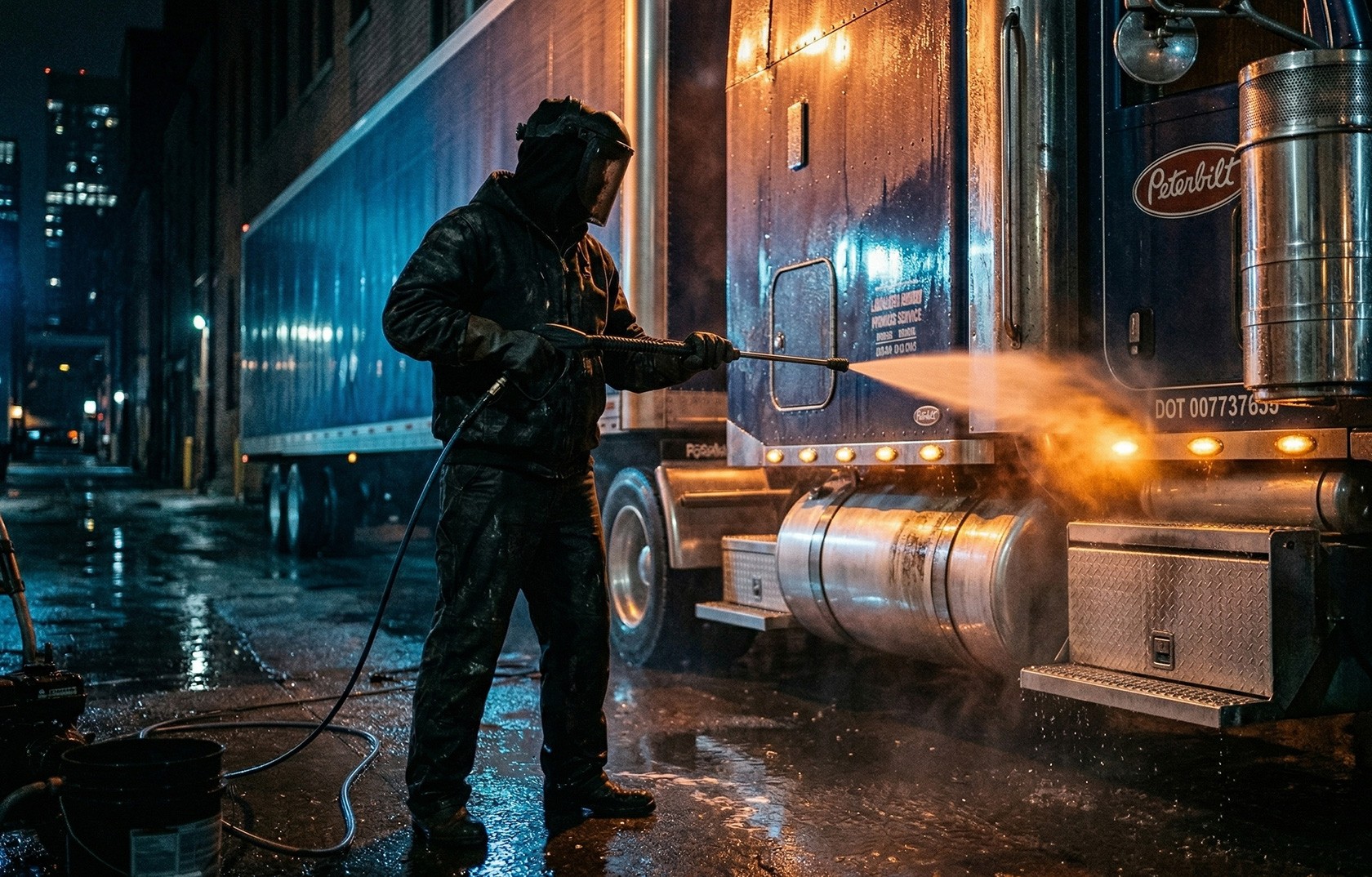
How do you wash a truck when ambient temperatures routinely drop to -40°F (with windchills plunging to a staggering -70°F)? Very carefully. Introducing water to a supercooled metal chassis is incredibly risky and alters the fundamental physics of cleaning.
The Flash Freeze Danger: It is a basic rule of cleaning that hot water works better than cold water. But in the Alaskan winter, hitting supercooled metal with steaming hot water can cause instantaneous flash freezing. The thermal energy of the water is rapidly absorbed by the freezing metal and frigid air, causing it to crystallize almost instantly. This can seal doors permanently shut, freeze vital pneumatic air brakes, and lock up steering linkages. Paradoxically, in deep freezes, operators often use cooler water (70°F to 90°F) to bridge the temperature differential and prevent this thermal shock.
Keep It Running: To combat the rapid freezing of wash water on the vehicle's surface, it is highly recommended to keep the truck's engine running during the entire cleaning process. For vehicles like reefer trailers, keeping the refrigeration units powered on helps radiate internal heat outward, significantly decreasing the rate of exterior icing.
Cutting Ice, Not Melting It: Before the corrosive salts can be addressed, the concrete-like chunks of accumulated ice must be removed from behind mud flaps and wheel wells. Trying to melt this ice with hot water is a massive waste of time, energy, and water. Instead, operators use high-pressure, zero-degree nozzles like "water scalpels" to physically slice the ice blocks off the vehicle.
Constant Fluid Motion: High-pressure hoses can freeze solid in minutes if left resting on the frozen Alaskan ground. The water must constantly flow through the pump and the hoses to prevent the equipment itself from freezing, expanding, and shattering internal brass manifolds.
Chemical Kinetics in the Cold
The efficacy of commercial detergents, heavy degreasers, and metal brighteners relies on chemical reactions. According to the laws of chemical kinetics, these reactions slow down drastically as temperatures plummet.
For example, the aluminum brightening agents and acid-based cleaners heavily relied upon by the trucking industry to remove oxidation and restore bare metal finishes experience a severe drop in effectiveness at temperatures below 60°F. To combat this thermodynamic handicap, Alaskan washers have to completely adjust their strategy:
Higher Concentrations & Extended Dwell Times: Operators must plan to use significantly more chemical soap and allow for extended "dwell times" (letting the soap sit on the truck longer) to achieve the same cleaning power they would get in the summer.
One-Step Hot Washes: In temperate climates, professional washers use a precise "two-step" process (an acidic soap followed by an alkaline soap). In Alaska, leaving multiple layers of liquid chemicals on a freezing truck is an operational hazard. Many operators pivot to a single, high-potency detergent injected directly into a hot-water stream for a rapid, single-pass rinse just to get the corrosive salts off.
Hydrophobic Sheathing Waxes: Adding specialized sheathing wax (like W-200 Spray Wax) to the final rinse reduces the surface tension of the water. This helps the water sheet off the truck rapidly in a cohesive cascade rather than pooling in crevices, speeding up the drying process and reducing the formation of dangerous micro-ice layers.
Alaska's Unforgiving Environmental Rules
Alaska possesses some of the most pristine, unpolluted, and economically vital marine and freshwater ecosystems in the world. As a result, the Alaska Department of Environmental Conservation (ADEC) treats commercial wastewater—including the seemingly innocuous runoff from washing a truck—with an intense degree of microscopic scrutiny.
Wash water is explicitly classified as an industrial pollutant. It contains concentrated levels of heavy metals (from brake dust), toxic volatile solvents, chemical de-icers, and high concentrations of oil and grease.
Zero Tolerance for Storm Drains: Dumping untreated wash water into Municipal Separate Storm Sewer Systems (MS4s) is an "illicit discharge." Storm drains channel water directly into local creeks and oceans without biological treatment. Dumping wash water into them results in severe financial penalties and violates the federal Clean Water Act.
Strict APDES Permitting: Discharging water directly into the environment requires an Alaska Pollutant Discharge Elimination System (APDES) permit. The ADEC places incredibly tight restrictions on these operations. For example, commercial facilities discharging into marine waters are often required to meet "end-of-pipe effluent limits with no authorized mixing zone." This means the wash water must be perfectly safe and non-toxic the absolute moment it exits the pipe; operators cannot rely on the vast dilution power of the ocean to lower the toxicity of the discharge.
Closed-Loop Solutions: Because obtaining and maintaining a surface discharge permit is a regulatory nightmare, the ADEC strongly favors closed-loop recycling systems. These advanced setups capture 100% of the wash water, mechanically and chemically filter out the suspended solids and hydrocarbons, and pump the purified water right back into the pressure washer for immediate reuse.
The Water Scarcity Paradox and Infrastructure
Despite Alaska containing millions of lakes and vast river systems, finding usable liquid water for industrial purposes during the winter is a profound logistical bottleneck.
In remote areas and native villages, municipal piped water systems are often entirely nonexistent. Water has to be laboriously hauled in or harvested directly from natural sources under extreme duress. In emergency scenarios in the Bush—such as the community of Tuluksak—transporting heavy liquids requires highly coordinated logistical efforts utilizing small air cargo carriers like DesertAir flying DC-3s, or heavy trucks traversing treacherous, temporary ice roads.
You cannot simply pull a mobile wash truck up to a remote North Slope oil camp and hope to find an unfrozen spigot. Mobile units must function as completely self-contained entities, hauling hundreds of gallons of water in massive buffer tanks inside heated box trucks to prevent their payload from becoming a useless block of ice before reaching the job site.
The Rise of the Indoor Wash Bay
Because mobile, outdoor fleet washing in the extreme cold is fraught with such severe operational hazards, the Alaskan commercial transportation sector relies heavily on centralized, indoor wash facilities located within the major urban centers of Anchorage and Fairbanks.
Operations represent massive capital investments in water heating, building insulation, and ADEC-approved wastewater management systems. Facilities like Mountain View Car Wash in Anchorage feature fully enclosed indoor bays with heavy overhead doors and integrated heating systems specifically scaled to accommodate mid-to-large commercial trucks and motorhomes. Other local operations like Monster Wash and Sudzy Salmon have engineered their facilities to offer 24/7 touchless environments, providing a completely thawed, safe space for heavy-duty cleaning.
However, this reliance on centralized facilities creates a severe operational challenge. Fleet vehicles operating deep in the Interior or on the Dalton Highway cannot easily divert hundreds of miles just for a routine wash, forcing them to endure prolonged periods of severe contamination.
Business Diversification: Surviving the Seasons
Given the compounding pressures of sub-zero temperatures, logistical isolation, and uncompromising environmental regulations, the Alaskan fleet washing industry is highly seasonal. Attempting to wash commercial fleets outdoors when temperatures fall far below zero can often end up costing an operator more money in frozen pumps and shattered hoses than they make on the job.
To survive and maintain a profitable business year-round, savvy operators strategically pivot their service offerings based on the season:
Winter Highway Equipment: While standard residential and commercial fleet calls dwindle to a trickle in the darkest months of winter, mobile washers often seek highly lucrative contracts washing heavy highway equipment and municipal snow plows. These entities absolutely require the corrosive road salts to be removed regularly to prevent the total destruction of their multimillion-dollar specialized fleets. Companies like Alaska Pressure Wash have successfully maintained mobile fleet washing operations in the Anchorage and Mat-Su Valley areas since 2008 by adapting to these rigorous commercial demands.
Spring Structural Soft Washing: As the Alaskan winter finally breaks, operators transition their heated equipment away from high-pressure industrial fleet washing to the highly profitable sector of residential and commercial structural maintenance. Winter is incredibly tough on building exteriors; snow, freezing temperatures, and limited sunlight create the perfect conditions for dirt, algae, mold, and mildew to build up on siding, soffits, and roofs. Operators use specialized "soft washing" techniques—a low-pressure method using customized chemicals—to safely remove this organic growth without the destructive force of traditional pressure washing, which can easily crack cold, brittle vinyl siding or force water behind structural barriers.
The Bottom Line
Commercial fleet washing in Alaska transcends the mundane reality of simple vehicle maintenance. It is a highly complex, multi-disciplinary undertaking that sits at the intersection of mechanical engineering, environmental chemistry, and high-stakes logistics.
Fleet managers and wash operators who succeed in the Last Frontier do so by aggressively abandoning the standard operating procedures utilized in the lower 48. They embrace highly engineered solutions, master sub-zero thermodynamics, and meticulously manage every drop of water to protect both their multimillion-dollar mechanical assets and the fragile, pristine Alaskan environment.
Join our newsletter list
Sign up to get the most recent blog articles in your email every week.