Home & Property
The Pressure Washing Mistakes That Cost Alaska Homeowners Thousands
9 Min Read
A pressure washer is one of the few tools that can make your property worse before it makes it better. Here are the seven DIY mistakes that send Alaska homeowners to repair bills in the thousands, with real numbers on what each one costs to fix.
The Pressure Washing Mistakes That Cost Alaska Homeowners Thousands
A pressure washer at Home Depot costs about $400. A four hour rental at the same place runs around $80. Looking at those numbers, you might assume that pressure washing your own house, deck, and driveway is one of those classic DIY wins where you save real money and end up with a clean property.
That math holds up only if nothing goes wrong.
We get calls every spring from homeowners who started out trying to save a few hundred dollars and ended up looking at repair bills in the thousands. Sometimes tens of thousands. The mistakes are usually the same handful, made by people who had no way of knowing they were about to do something irreversible.
Here's what they are, what they cost to fix, and why a pressure washer is one of the few tools that can genuinely make a property worse before it makes it better.
Mistake 1: Etching the concrete with a wand
The most common DIY damage we see is on driveways and walkways. It happens because a standard pressure washer wand puts all its force into a small contact patch, and unless you're moving it at a very specific speed at a very specific distance, you're going to leave marks.
The marks look like tiger stripes. Light bands where the wand was further away or moving faster, dark bands where it was closer or paused. They show up clearly once the concrete dries and the contrast becomes obvious. They don't go away. The concrete in those bands has been physically eroded, and the surface texture is permanently different.
A professional uses a surface cleaner instead of a wand for any flat concrete work. A surface cleaner is a rotating spinner enclosed in a shroud that distributes pressure evenly across a 16 to 20 inch path. The result is a uniform clean with no banding.
Repair options for etched concrete are limited. Light etching can sometimes be masked with a concrete stain or sealer. Heavy etching usually requires resurfacing, which runs $5 to $15 per square foot. On a 600 square foot driveway you're looking at $3,000 to $9,000 for damage you caused in an afternoon.
Mistake 2: Blowing holes in your siding
Alaska has a lot of cedar siding, T1-11 plywood siding, and vinyl siding. All three are easy to damage with a pressure washer.
Cedar is soft. At 2,500 PSI or higher, held close, the spray will tear fibers off the wood. The boards develop a fuzzy, splintered surface that not only looks bad but no longer sheds water properly. Once it's furred up, the only fix is to sand it smooth and refinish, which on a full house exterior runs $4 to $8 per square foot of wall area.
T1-11 has a thin veneer layer over particleboard. Strip the veneer and you've exposed the particleboard to weather, which means those boards are going to fail. Replacement runs about $3 to $6 per square foot, plus paint or stain.
Vinyl is the trickiest. It looks tough but at the wrong angle, pressure can crack it, force water behind it, or hammer the locking edges loose. The damage isn't always visible immediately. You see it three months later when the water that got behind the panel rots out the sheathing underneath.
A professional uses a soft wash technique for all three. Low pressure, around 100 to 200 PSI, with chemistry that does the work instead of the pressure. The siding never gets touched by anything aggressive.
Mistake 3: Forcing water where water isn't supposed to be
This is the most expensive mistake on the list because the damage is hidden. You see a clean exterior and assume you did a great job. Six months later you're tearing out drywall.
A pressure washer at 3,000 PSI is putting out a stream of water with enough force to drive itself behind your siding, under your shingles, around your window frames, into your soffit vents, and through the seals around your dryer vent, bathroom exhaust, and electrical penetrations.
Once water is inside the wall cavity, it has nowhere to go. Insulation soaks it up and holds it against the framing. Mold starts within 48 hours in the right temperature range. Within a season the drywall is staining, the framing is rotting, and you have a remediation project on your hands that easily runs $5,000 to $20,000 depending on how far the water traveled.
The two specific spots where this happens most often are spraying upward toward the underside of horizontal siding lap joints, and spraying directly at window and door frames. Both should always be done from below with the spray angled downward, and never with high pressure aimed at any seam.
Mistake 4: Stripping your deck instead of cleaning it
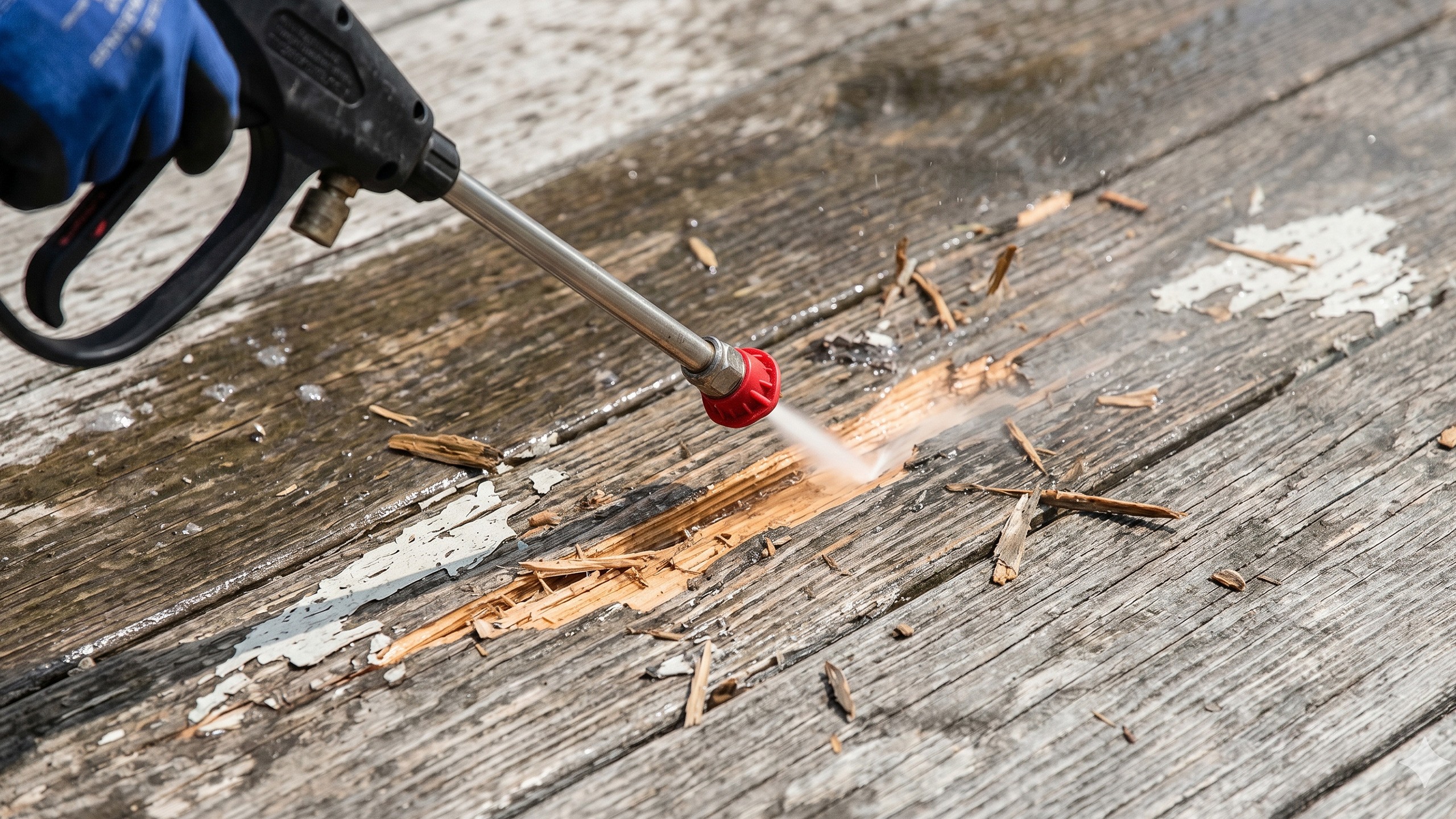
Deck wood is even softer than siding. Cedar, pine, and pressure treated lumber all fuzz up quickly under aggressive pressure, and the protective coatings on a sealed deck get stripped off in the same pass.
The result is a deck that looks clean for about a week, then starts greying and weathering rapidly because the stain or sealer that was protecting the wood is gone. Within a season the deck looks worse than it did before you washed it. Refinishing means a full sand and reseal, which runs $4 to $8 per square foot. On a 400 square foot deck that's $1,600 to $3,200 to repair the damage from one Saturday afternoon.
The right approach for decks is low pressure cleaning with a dedicated deck cleaner. The chemistry lifts the dirt without touching the wood or the sealer. A pro will also reseal the deck after cleaning if needed, which is a much smaller job than refinishing one that's been damaged.
Mistake 5: Killing your landscaping
Most pressure wash chemistry contains sodium hypochlorite (bleach) or sodium hydroxide. Both are murder on plants.
A homeowner mixing their own chemistry from a YouTube recipe often uses concentrations that are way higher than necessary, then sprays it directly onto siding that drains down onto the landscaping below. The chemistry runs off the wall, soaks into the soil around the foundation, and kills everything within a foot or two of the house.
A few weeks later the homeowner is replacing $500 to $2,000 worth of shrubs, perennials, and groundcover that took years to establish. In Alaska, where the growing season is short and many of those plants needed multiple seasons to mature, the real cost is higher in time than in dollars. Replacing a five year old lilac with a one gallon nursery start means waiting half a decade to get back to where you were.
A professional pre-wets all landscaping before applying any chemistry, uses concentrations dialed in for the specific job, and rinses the surrounding area thoroughly afterward. The chemistry never gets concentrated enough or stays in contact long enough to cause damage.
Mistake 6: Pressure washing your roof
This is the most expensive DIY mistake on the list, by far.
Asphalt shingles have a layer of granules on top that protect the asphalt from UV damage. Those granules are what give the shingle its color and most of its lifespan. A pressure washer aimed at a shingle roof blows the granules off in sheets. You see them in the gutters and on the ground around the house afterward.
A roof that's had its granules stripped loses an enormous chunk of its remaining life. We've seen 15 year old roofs that were good for another 10 years lose 7 of those years to a single aggressive wash. The homeowner ends up replacing the roof years early, which on an average Alaska home is $15,000 to $35,000.
It also voids most shingle warranties. Pressure washing is specifically excluded in the warranty language of every major shingle manufacturer, which means if the roof fails prematurely after a DIY wash, you're paying for the full replacement yourself.
Metal roofs aren't immune either. Pressure can drive water under panels, crack sealants, and force water into screw holes. The damage isn't as immediate as on shingles but it shortens the roof's life and creates leak points that show up years later.
The right approach for any roof is soft washing. Low pressure, applied chemistry, gentle rinse. The roof looks just as clean and loses none of its life.
Mistake 7: Getting hurt
A 3,000 PSI stream of water can cut through skin, drive bacteria into the wound, and cause infections that require surgery. Pressure washer injuries send thousands of people to the ER every year, and the wounds look minor on the outside but require deep cleaning and sometimes debridement.
Beyond the spray itself, there's the ladder factor. Most serious pressure washing injuries happen when a homeowner tries to reach a second story surface from a ladder, the wand kicks back from the recoil, and they fall. Add in electrical hazards from working around outdoor outlets, soffit lights, and meter boxes, and the risks compound fast.
This is the one mistake that doesn't have a clean dollar figure attached, but it's the one that should weigh heaviest in the DIY versus hire decision. A trip to the ER plus time off work plus the long tail of a wound that won't heal properly can easily eclipse anything else on this list.
When DIY is actually fine
To be fair, there are jobs where a homeowner pressure washer is perfectly appropriate. Cleaning patio furniture, washing the truck or boat in the driveway, blasting mud off a lawn mower deck. Anything where the surface is durable, the angle is downward, and there's no risk of water intrusion into a building.
Where DIY breaks down is anything involving the house itself, the roof, large concrete surfaces, decks with finish work, or chemistry. Those are jobs where the math stops favoring DIY pretty quickly once you factor in the risk of permanent damage.
What it actually costs to hire out
A professional house wash for a typical Alaska home runs a few hundred dollars. A driveway runs $0.20 to $0.40 per square foot. A deck cleaning runs $1 to $2 per square foot, with reseal adding to that if needed. Even a complete exterior package including house, driveway, walkways, and deck usually comes in well under what one mistake from this list would cost to repair.
The math gets even better when you factor in the time. A weekend you would have spent washing your own property is a weekend you didn't have to spend washing your own property. The pro brings their own water, their own chemistry, their own equipment, and their own insurance. You hand over a credit card and the work just happens.
If you're in the Mat-Su Valley or Greater Anchorage and you want to walk through what makes sense for your property, give us a call. We'll come look at what needs to be done, point out anything that should be left alone, and put together a quote that's almost certainly less than what one of these mistakes would cost to undo.
Join our newsletter list
Sign up to get the most recent blog articles in your email every week.